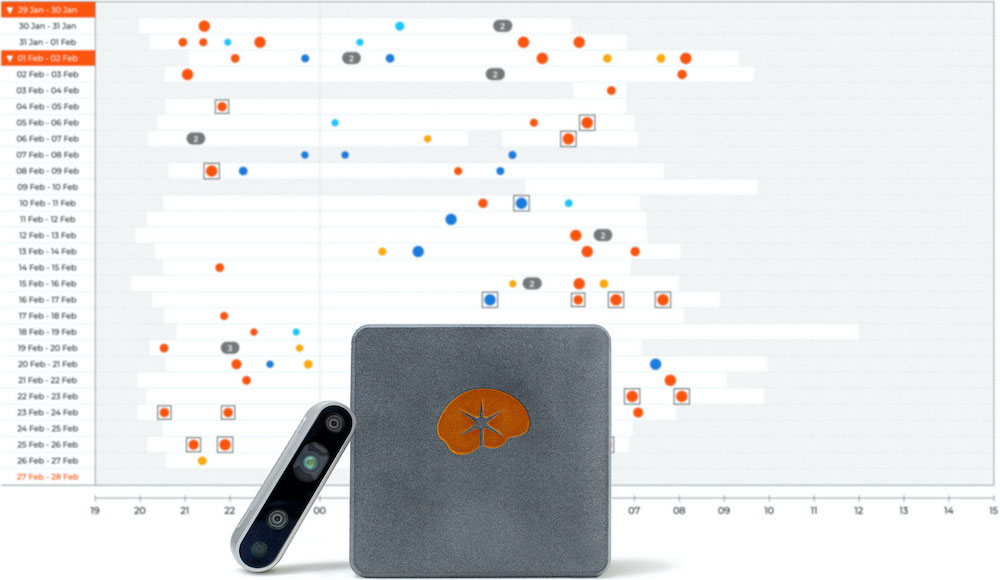
Nelli is currently offered for use in the United States, in the European Union, and in the United Kingdom.
US: Cleared as Substantially Equivalent to a legally marketed device under 21 CFR §807. Restricted to sale by or on the order of a physician.
EU: CE marked as a Class IIa medical device in accordance with Regulation (EU) 2017/745.
UK: Registered as a Class IIa medical device in accordance with UK Medical Devices Regulations 2002 No. 618.

See
Fast and accurate seizure detection at home* and in the hospital
Learn
Objective and easy-to-use data provided by AI and reviewed by a human expert
Improve
Enhances current diagnostic and follow up methodsNelli analyzes audio/video recordings to identify events indicative of motor seizures.
Video and audio recordings of the patient are captured via a Personal Recording Unit (PRU) with camera and microphone.
Nelli includes a web-based dashboard for viewing the analysis results. Relevant moments are identified by machine learning algorithms, resulting in an interactive report to be reviewed by the physician. In addition, Neuro Event Labs offers an optional service for expert review by credentialed clinical staff.
Research supports accuracy of seizure detection
In a European in-hospital study validating Nelli against video-electroencephalogram monitoring in 230 patients aged 0-80 years
-
88%
Sensitivity for all motor seizures1
-
95.2%
Sensitivity for convulsive seizures1
-
6.48
False detection rate per hour for all motor seizures 1
1 Rai P. et al. Automated analysis and detection of epileptic seizures in video recordings using Artificial Intelligence. Frontiers in Neuroinformatics (2024).
In a study with 104 patients monitored for an average of 29 days, using Nelli led to
-
>86%
Clinical decisions2
-
83
Differential diagnosis of all patients with recorded epidoses2
-
68%
Therapeutic interventions or adjustments2
2 Basnyat P. et al. Clinical utility of a video/audio-based epilepsy monitoring system Nelli. Epilepsy & Behavior (2022).